How Reading Builds Your Child's Brain While Screens Break Connections
Your child finishes dinner and asks for the iPad. You hesitate. In the back of your mind, you know screens aren't ideal—but the dishes are piling up, and thirty minutes of peace sounds reasonable. Here's what happens next, according to brain imaging research: the neural pathways your child needs to become a strong reader begin to weaken.
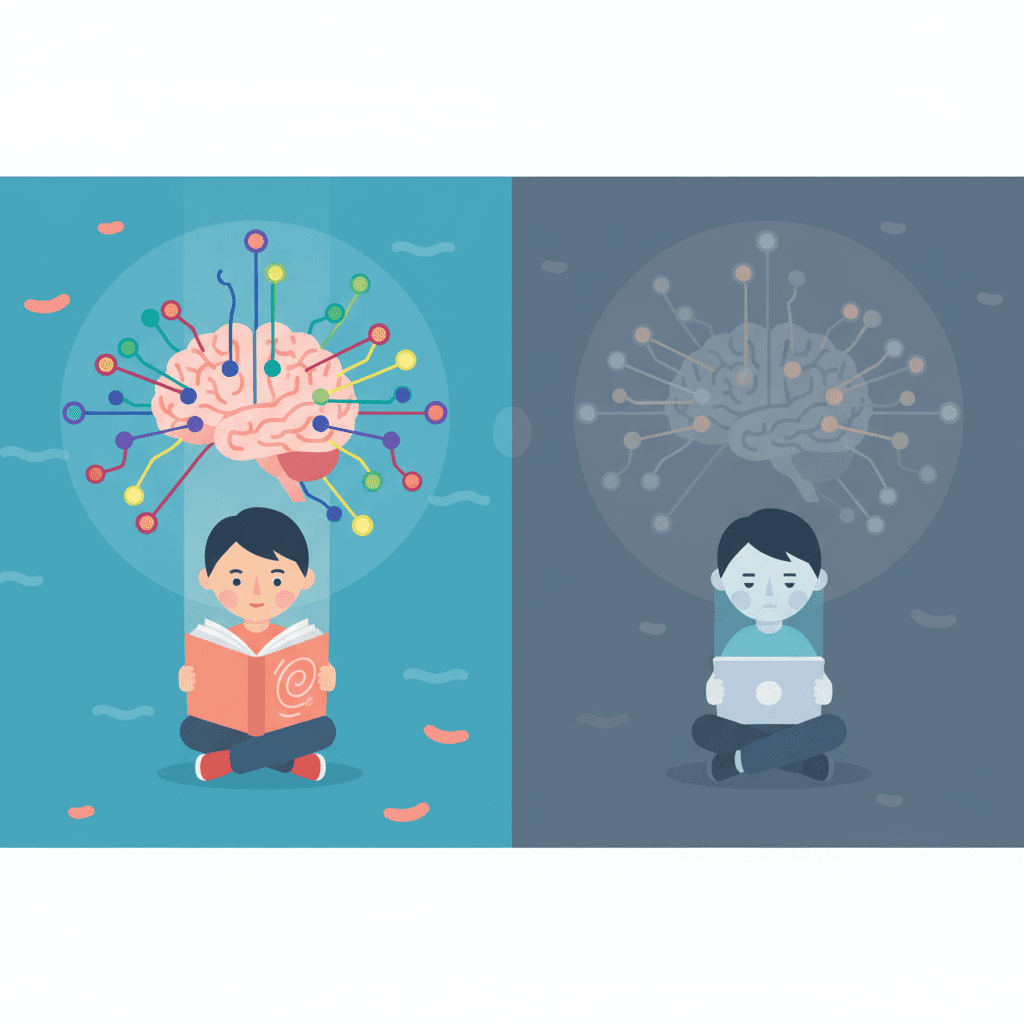
A 2018 study published in Acta Paediatrica used MRI technology to observe what different activities do to children's brains. The results were stark. Reading strengthened brain connectivity. Screen time weakened it. These weren't marginal differences—they were measurable changes in how language, visual processing, and cognitive control regions communicate with each other.
For parents trying to raise capable readers, this research offers both a warning and a roadmap.
What the Research Reveals About Reading and Brain Development
Researchers Tzipi Horowitz-Kraus and John S. Hutton at Cincinnati Children's Hospital Medical Center recruited 19 children between ages 8 and 12. Parents reported how much time their children spent reading independently versus using screen-based media (smartphones, tablets, computers, and television). Each child then underwent functional MRI scanning to measure resting-state brain connectivity.
The researchers focused on the left visual word form area—a brain region critical for recognizing written words. They wanted to see how this area communicated with other regions during rest.
The findings were clear:
Reading time correlated with stronger connections between the visual word form area and three critical zones: language processing regions, visual processing centers, and cognitive control areas. Children who read more had brains that worked together more efficiently.
Screen time correlated with weaker connections between the visual word form area and regions responsible for language and cognitive control. The more screens, the less integration between these essential systems.
Why Brain Connectivity Matters for Your Child's Future
Think of brain connectivity like a highway system. Strong connections mean information travels quickly between regions. Weak connections mean traffic jams, detours, and delays.
When your child reads, their brain practices coordinating visual input (seeing words), language processing (understanding meaning), and cognitive control (staying focused and thinking critically). These regions fire together, wire together, and build efficient pathways.
When your child watches screens, the brain receives passive stimulation. The visual word form area—the region that must work hard during reading—gets less practice coordinating with other systems. Over time, this matters. Children with stronger brain connectivity in these areas become better readers, stronger students, and more capable thinkers.
The Screen Time Problem Parents Face
No parent hands their child a tablet hoping to damage their brain development. The problem is practical: screens are everywhere, content is endless, and modern life demands constant multitasking from exhausted caregivers.
But the Horowitz-Kraus and Hutton study quantifies what many parents intuit. Screens aren't neutral. They actively work against the brain development reading provides. Every hour spent watching videos or playing games is an hour not spent building the neural architecture children need for literacy.
The question becomes: how do you make reading compete with the instant gratification of screens?
What Makes Reading Engaging Enough to Replace Screens
The study's authors emphasize that children need to spend time reading—not just being read to, and certainly not just having books available. Independent reading builds these connections. But getting children to choose books over screens requires content that captures their attention and refuses to let go.
Generic stories fail this test. A child who appears in their own adventure, making choices that shape the narrative, discovering characters who know their name—that child has a reason to pick up the story again tomorrow.
Personalization creates investment. When children see themselves as protagonists, reading becomes an experience rather than an assignment. The Horowitz-Kraus and Hutton research shows that time spent reading builds brain connectivity. The challenge is creating reading experiences compelling enough that children choose them willingly.
How Petit Tales Applies This Science
Petit Tales creates personalized bedtime stories where your child is the main character. Each story features their name, their interests, and their choices. The narrative continues across multiple chapters, building a saga that children want to return to night after night.
This design directly addresses the engagement problem the research highlights. Petit Tales provides:
Personalized protagonists that make children eager to discover what happens next. When Maya the astronaut or Lucas the dragon trainer is actually your child, the story stops being something to endure and becomes something to anticipate.
Continuing narratives that build over time. Each chapter ends with a reason to return tomorrow. This structure creates reading habits—the repeated, independent reading time that strengthens brain connectivity.
Bedtime-appropriate content designed for the transition to sleep. Unlike screens that stimulate and disrupt, these stories calm while still engaging. Parents can feel confident about the reading happening in those crucial pre-sleep minutes.
AI-generated stories that adapt to your child and your family's values. You provide input about what matters—courage, kindness, problem-solving—and the stories weave these elements naturally into the adventure.
Building Better Readers Starts Tonight
The Horowitz-Kraus and Hutton study measured children aged 8 to 12, but brain development begins much earlier. The reading habits you establish now—the neural pathways you help strengthen tonight and tomorrow night and the night after—shape your child's cognitive future.
Every bedtime is an opportunity. You can hand over a screen and watch connectivity weaken. Or you can open a story that puts your child at the center of an adventure worth following.
The science is clear. Reading builds brains. Screens don't. The only question is whether the stories available to your family are compelling enough to win that competition.
Petit Tales exists because generic picture books can't compete with YouTube, but personalized adventures can. When your child is the hero, the book becomes irresistible.
Start your child's personalized story saga tonight. Visit petittales.com to create their first adventure. The brain connectivity they build now becomes the reading ability they carry forward for life.
Reference: Horowitz-Kraus, T., & Hutton, J. S. (2018). Brain connectivity in children is increased by the time they spend reading books and decreased by the length of exposure to screen-based media. Acta Paediatrica, 107(4), 685-693.